
Rolex Deepsea




THE WATCH OF THE OCEAN DEPTHS
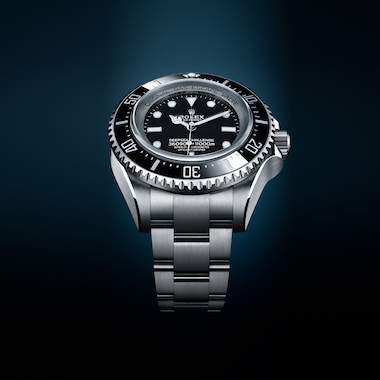
Waterproof to a depth of 11,000 metres (36,090 feet), the Oyster Perpetual Deepsea Challenge is designed to withstand phenomenal underwater pressure. Crafted from RLX titanium, it embodies a perfect balance of superlative technical performance and wearer comfort.
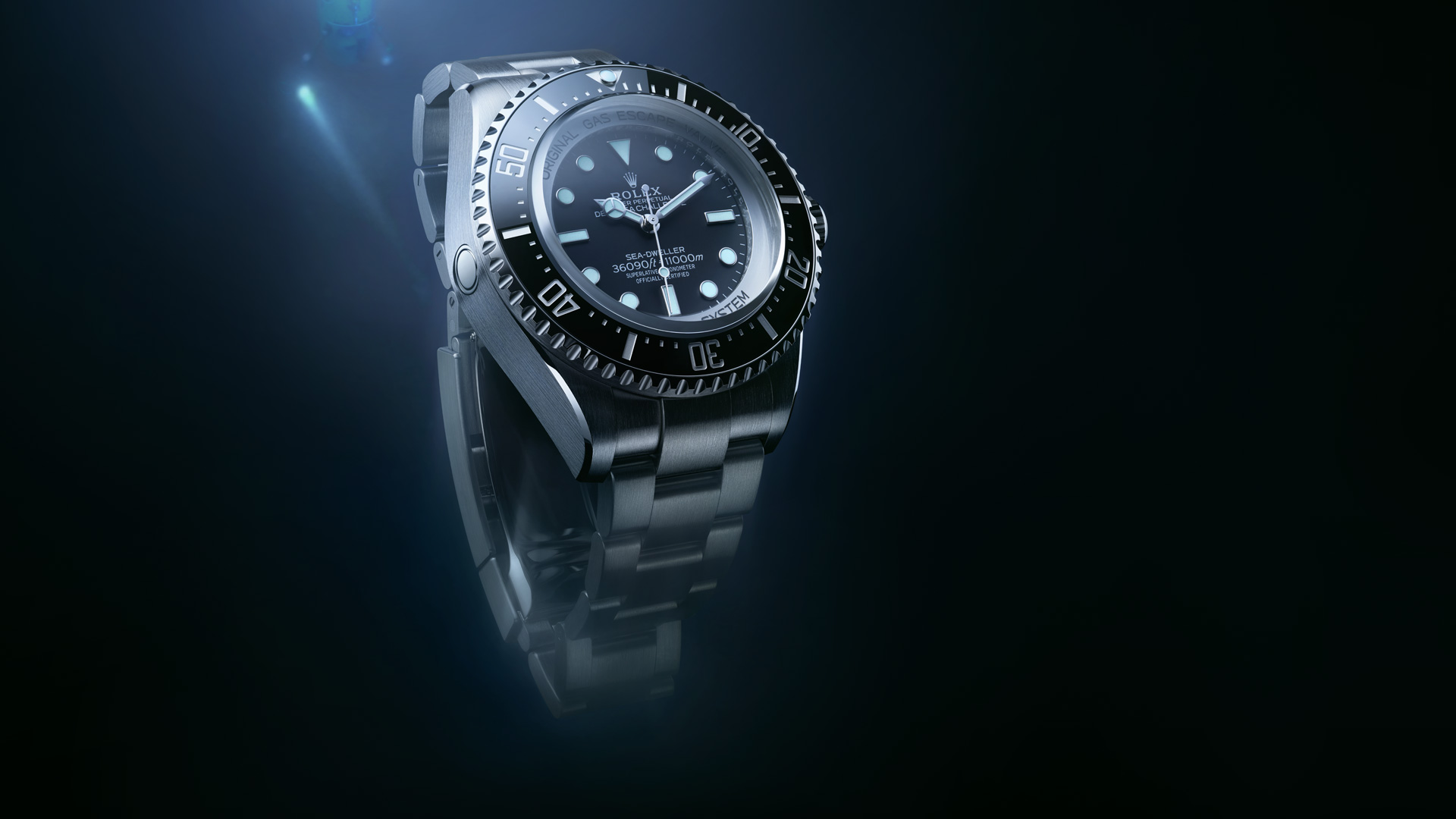
Guaranteed waterproof to the ultra-abyssal depth of 11,000 metres (36,090 feet), the Deepsea Challenge reaffirms Rolex’s legitimacy as a pioneering brand in the world of watches for deep-sea diving and its expertise in waterproofness and resistance to underwater pressure. Unveiled at the end of 2022, this model made of RLX titanium is inspired by the Rolex Deepsea Challenge – the experimental watch that accompanied filmmaker and explorer James Cameron into the Mariana Trench in 2012, attached to the exterior of his submersible. Although a large-sized watch, the Deepsea Challenge is both visually harmonious and comfortable to wear, thanks to its balanced proportions, carefully considered design and the alloy from which it is made.
The Deepsea Challenge is engraved on the case back with the words ‘Mariana Trench’ as well as the dates ‘23-01-1960’ and ‘26-03-2012’. These markings pay homage to two historic dives into the Mariana Trench, the ocean’s deepest point: that of oceanographer Jacques Piccard and U.S. Navy Lieutenant Don Walsh aboard the bathyscaphe Trieste in 1960, and that of James Cameron in his submersible DEEPSEA CHALLENGER in 2012. An experimental Rolex watch accompanied each of these feats, strapped to the outside of the vessel: the Deep Sea Special in 1960 and the Rolex Deepsea Challenge in 2012 both returned to the surface in perfect working order.
OYSTER CASE AND RINGLOCK SYSTEM
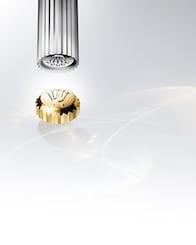
The 50 mm Oyster case of the Deepsea Challenge is a paragon of robustness and reliability. The middle case is crafted from a solid block of RLX titanium. The Triplock winding crown, fitted with a triple waterproofness system and protected by an integral crown guard, screws down securely against the case, helping to ensure its complete watertightness.
The Deepsea Challenge benefits from the Ringlock system, a patented case architecture developed by Rolex that allows it to resist the colossal pressure exerted by water at a depth of 11,000 metres.
The Ringlock system is based on three superposed elements:
• a thick, slightly domed sapphire crystal with an anti-reflective coating – on the Deepsea Challenge, it is 9.5 mm thick;
• a high-performance ring, positioned inside the middle case of the watch between the crystal and the case back, which alone bears the pressure exerted by the water – on this watch, the ring is made of nitrogen-alloyed steel; it has also been cold-worked, i.e. ‘crushed’ by a press, which increases its resistance to deformation while reducing its volume by approximately 10 per cent;
• a case back made from RLX titanium – which, here, screws down directly onto the middle case.
The Oyster case of the Deepsea Challenge is also equipped with the helium escape valve, patented in 1967. This safety valve works to protect Rolex divers’ watches created for great depths by allowing excess pressure built up inside the watch case to escape during a diver’s decompression phase in a hyperbaric chamber – a process inherent to saturation diving – without compromising the waterproofness of the watch. On the Deepsea Challenge, the helium escape valve is made of RLX titanium, the same material as the case and bracelet.
STRINGENT WATERPROOFNESS TESTS
In deep-sea diving, absolute reliability and security are of the essence. The waterproofness of every Deepsea Challenge watch is tested with a safety margin of 25 per cent, in accordance with the international standard in effect for divers’ watches.
The Deepsea Challenge, guaranteed waterproof to a depth of 11,000 metres, is thus effectively subjected to the pressure exerted at a depth of 13,750 metres. For these stringent tests, Rolex developed an ultra-high-pressure (UHP) tank in conjunction with Comex (Compagnie Maritime d’Expertises), the world-renowned French company specializing in underwater engineering and hyperbaric technologies. The watch’s crystal therefore withstands the equivalent of almost 15 tonnes, the compression ring 17 tonnes, and the case back 19 tonnes.
CERACHROM BEZEL INSERT
The unidirectional rotatable bezel of the Deepsea Challenge is fitted with a 60-minute graduated monobloc Cerachrom insert in black ceramic that allows divers to monitor their time underwater. This insert is made of an extremely hard, virtually scratchproof ceramic whose colour is unaffected by ultraviolet rays. In addition, thanks to its chemical composition, the high-tech ceramic is inert and cannot corrode. The moulded, recessed numerals and graduations are coated with platinum using a PVD (Physical Vapour Deposition) process. The bezel’s knurled edge offers excellent grip and can be manipulated with ease, even when wearing gloves.
LEGIBLE AND FUNCTIONAL
In the underwater depths, being able to read the time with absolute certainty is a matter of survival. Great attention was paid to the legibility of the Deepsea Challenge: the dial of this professional divers’ watch features a pared-back design and incorporates the Chromalight display. The simple forms of the hour markers – triangles, circles and rectangles – and the hands, which are clearly differentiated in size and shape, are filled or coated with a luminescent material emitting a long-lasting blue glow. On the bezel, the triangular ‘zero’ marker of the graduation is visible in the dark thanks to an embedded capsule containing the same luminescent material.
BRACELET AND CLASP: SECURITY AND COMFORT
The Deepsea Challenge is fitted on a three-piece link Oyster bracelet. Equipped with a Rolex-designed Oysterlock safety clasp that prevents accidental opening, this bracelet features the patented Rolex Glidelock extension system, also developed by the brand. On the Oyster bracelet, this inventive toothed mechanism has 10 notches of approximately 2 mm, allowing the bracelet length to be effortlessly adjusted by approximately 20 mm. The watch can therefore be worn over a diving suit up to 3 mm thick.
The Oyster bracelet of the Deepsea Challenge is additionally equipped with the Fliplock extension link, whose fold-out blades enable the bracelet to be extended by approximately 26 mm. When the two extension systems are combined, the watch can be worn over a diving suit up to 7 mm thick.
Made from RLX titanium, the Oyster bracelet of the Deepsea Challenge includes ceramic inserts – designed by Rolex and patented – around the pins inside the links to help prevent premature wear and to enhance its flexibility on the wrist.
CALIBRE 3230
The Deepsea Challenge is equipped with calibre 3230, a self-winding mechanical movement entirely developed and manufactured by Rolex. A distillation of technology, this movement carries a number of patents. It offers outstanding performance, particularly in terms of precision, power reserve, convenience and reliability.
Calibre 3230 incorporates the patented Chronergy escapement, made of nickel-phosphorus, which combines high energy efficiency with great dependability and is resistant to strong magnetic fields.
The movement is additionally fitted with the blue Parachrom hairspring. Manufactured in a paramagnetic alloy enabling it to withstand strong magnetic fields, this hairspring also offers great stability in the face of temperature variations as well as high resistance to shocks. It is equipped with a Rolex overcoil, ensuring the calibre’s regularity in any position.
The oscillator of calibre 3230 has a large balance wheel with variable inertia regulated extremely precisely via gold Microstella nuts. It is held firmly in place by a height-adjustable traversing bridge enabling very stable positioning to increase shock resistance. The oscillator is also mounted on the Rolex-designed, high-performance Paraflex shock absorbers, further enhancing the movement’s shock resistance.
Calibre 3230 is equipped with a self-winding system via a Perpetual rotor, which ensures continuous winding of the mainspring by harnessing the movements of the wrist to provide a constant source of energy. Thanks to its barrel architecture and the escapement’s superior efficiency, the power reserve of this movement extends to approximately 70 hours.
The Deepsea Challenge’s movement is beautifully finished and decorated. Since 2023, it has also been marked with the words ‘Chronometer Perpetual’ and ‘Superlative Adjusted’ engraved on the oscillating weight and on the bridges, respectively.
THE DEEPSEA CHALLENGE, SUPERLATIVE CHRONOMETER CERTIFIED
Like all Rolex watches, the Deepsea Challenge is covered by the Superlative Chronometer certification. Symbolized by a green seal, this in-house certification is strictly controlled by internationally recognized, independent Swiss entities. It ensures the excellent on-the-wrist performance of each of the brand’s watches and is coupled with an international five-year guarantee.
In 2026, the Superlative Chronometer certification was expanded to seven testing criteria. Resistance to magnetism, reliability and durability were added to the criteria for precision, waterproofness, self-winding and autonomy, established when the certification was redefined in 2015.
The requirements in terms of precision are particularly stringent. Each Rolex movement is first officially certified as a chronometer. This means that, having passed a series of eliminating tests, it fulfils the criteria governing the ‘chronometer’ designation for wristwatches. For the category of calibres concerned, which includes all Rolex movements, the tolerated rate deviation is –4 and +6 seconds per day.
After casing the movement, the precision is then tested again, following a protocol developed by Rolex that simulates real-life wearing conditions, to meet even stricter criteria: the watch’s accuracy must be between –2 and +2 seconds per day. The rate deviation tolerated by the brand for a finished watch is therefore significantly smaller than that accepted for official certification of the movement alone.

